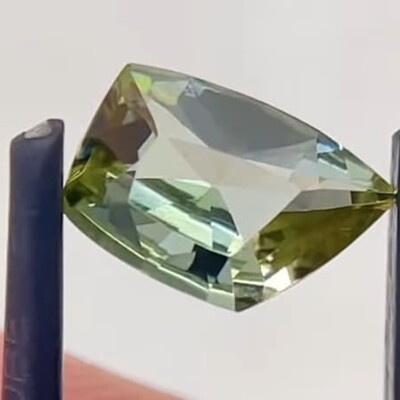
Stone Description
Tanzanite is best known for its deep violet-blue color, but there are now a variety of other shades that are marketed as fancy-colored tanzanite. Some of these are quite rare and valuable.
Violet-blue tanzanite is produced by low-temperature heating of brownish or greenish zoisite found in Tanzania. The name “tanzanite” was originally applied to this distinctive color when Tiffany & Co. named and sold the gem after its discovery in 1967.
Initially, there was no market for untreated zoisite, much of which was not particularly attractive before heating. But through extensive mining in Tanzania, rare and beautiful colors of natural zoisite have been found and are now sold as fancy-colored tanzanite (although technically they should be called “fancy-colored zoisite”). These include green, gold, orange, green-blue, pink, and purple colors.
The key to the value of fancy-colored tanzanite is the purity of the coloration. Most zoisites have a brown or gray secondary tint, and these muted colors are undesirable. Bright pinks, greens, yellows and oranges are rare and are sought after by collectors. Most beautiful fancy colors are only found in small sizes (less than 1 carat) and large specimens are very rare, especially the purer colors.
The opaque massive form of pink zoisite is known as tulite and is relatively common. But in crystalline form, pink is very rare, and transparent zoisite of any shade of pink is quite valuable. Pink and violet shades are the rarest and most valuable of the fancy tanzites, often selling for 2-3 times the price of beautiful blue tanzanite. Chrome green tanzanite is the next rarest, followed by bright orange and yellow.
In the case of purple-blue tanzanite, there is no premium for unheated stones, as the purple-blue hue is usually produced by low-temperature heating. Fancy-colored tanzanites are completely untreated, and this fact is valued by many collectors.
Translated with DeepL.com (free version)