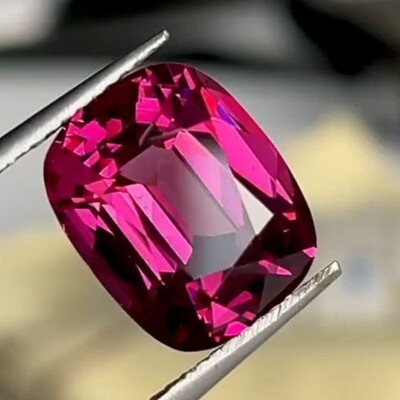
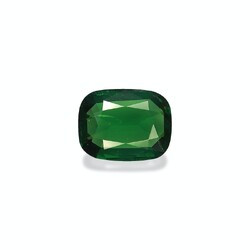
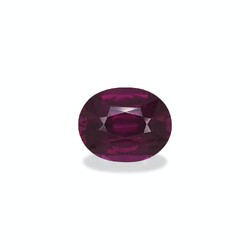
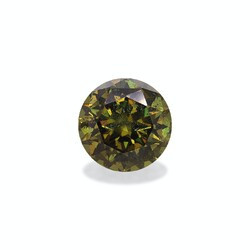
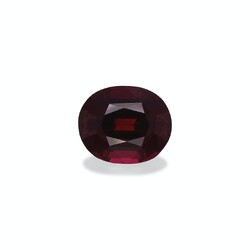
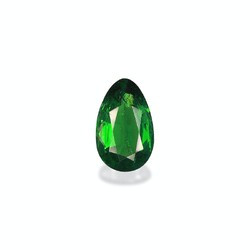
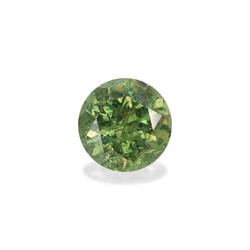
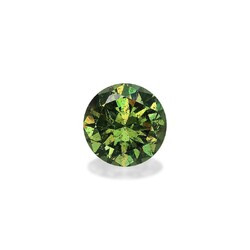
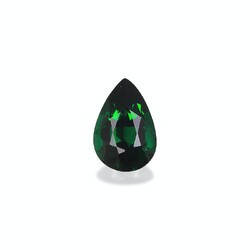
Natural Garnet Gemstones — Tsavorite, Demantoid, Spessartine & More
By Russell, VividCarat — China Fort Market, Beruwala, Sri Lanka
Most people come to garnet through the wrong door.
They picture the dark red stone in a grandmother's ring, or the $15 cabochon in a souvenir shop by the beach. That stone exists, it's garnet, and it costs what it costs. But it shares a name with stones that sell for $5,000 per carat at auction, with a green that rivals the finest Colombian emerald, with a variety that has the highest dispersion of any natural gemstone on Earth — higher than diamond.
The word "garnet" covers eleven distinct species, a full color spectrum, and a price range from $5 to $10,000 per carat depending entirely on which garnet you're talking about. This page covers the ones worth talking about. Each variety has its own page in the catalog — links at the bottom.
What You'll Actually Pay — by Variety
| Variety | Color | Carat | Price Range (USD/ct) | Certificate |
|---|---|---|---|---|
| Rhodolite | Raspberry to purple-red | 1–15 ct | $30–200 | Optional |
| Pyrope / Almandine | Deep red | 1–5 ct | $20–150 | Optional |
| Spessartine — commercial | Orange with modifiers | 1–5 ct | $80–350 | Optional |
| Spessartine — Mandarin | Pure orange, Namibia/Nigeria | 1–8 ct | $400–1,800 | GIA recommended |
| Tsavorite | Chrome green, Kenya/Tanzania | 0.5–3 ct | $400–2,500 | GIA recommended |
| Malaya / Umbalite | Orange-pink to peach | 1–5 ct | $150–600 | Optional |
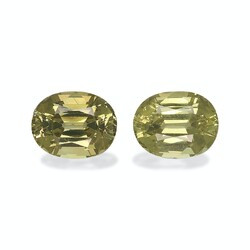
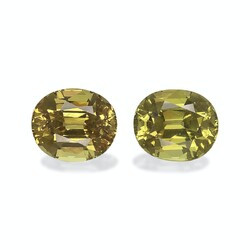
| Mali garnet | Yellow-green to lime | 1–8 ct | $150–500 | Optional |
| Demantoid — African | Vivid green | 1–8 ct | $300–1,200 | GIA recommended |
| Demantoid — Russian | Green + horsetail inclusions | 0.5–2 ct | $1,500–8,000+ | GIA + Russian origin required |
| Color-change garnet | Green/red shift by light | 0.5–3 ct | $500–3,000 | GIA color-change confirmed |
All garnets in this catalog are unheated and untreated — no exceptions. Garnet is the only major category on this site where treatment is essentially absent from commercial material. No heating, no oiling, no fracture filling. The certificate has no treatment disclosure because there is nothing to disclose.
Tsavorite — Kenya's Answer to Emerald
The first time I held a fine tsavorite next to a fine Colombian emerald, I understood the argument that had been running through the trade since 1967.
Campbell Bridges found tsavorite in Tanzania, then later in Kenya, in the same year Neil Armstrong walked on the moon. He spent years working the deposit under conditions that most people making decisions about gemstones never think about — he was killed by a mob in 2009 near his mine in Kenya, a dispute over land that had been going on for decades. The stone carries that weight if you know the story.
What comes out of the ground in the Tsavo region is a grossular garnet colored by vanadium and chromium — the same elements that color emerald green. Under a lab lamp, a fine tsavorite and a fine Colombian emerald are genuinely difficult to distinguish. In daylight the tsavorite often wins: better average clarity, no jardin, no treatment of any kind, higher refractive index, stronger brilliance. It does not have the Colombian origin premium. That premium is real — history and collector demand are real — but the stone in a direct comparison holds its own.
I keep tsavorite in the catalog because it is the most honest value in green gemstones at the $400–2,500/ct level. If you want green and don't need the word "emerald" on the certificate, tsavorite gives you more stone per dollar than almost anything else.
Tsavorite vs Emerald — Said Plainly
A fine tsavorite and a fine Colombian emerald in the same color range, same size, same clarity will be visually comparable to most buyers in most lighting. The tsavorite will have better clarity and no treatment history. The price will be 40–60% lower.
What the emerald has: Colombian origin premium, four centuries of collector demand, a name every buyer recognizes, and the specific warmth of Muzo green that is genuinely different under careful comparison.
Buying for visual impact in jewelry: tsavorite is the better value. Buying with resale or provenance in mind: Colombian emerald is justified. I tell clients this on the call. Some switch to tsavorite. Some confirm they want the emerald anyway. Both are right answers for the right buyer.
Demantoid — The One Where Inclusions Raise the Price
There is one garnet variety where finding inclusions increases value. Every other gemstone category works the opposite way. Demantoid is the exception.
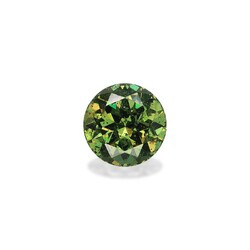
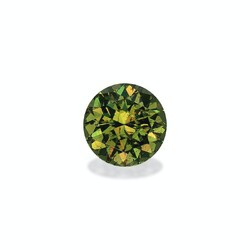
Demantoid from Russia's Ural Mountains — found in 1868 — often contains byssolite inclusions: fine golden fibers arranged in curved patterns that gemologists call "horsetails." A stone with prominent horsetail inclusions under magnification is confirmed Russian origin. Russian demantoid commands a premium that African material doesn't reach. The horsetail is the proof.
The dispersion of demantoid — the fire, the rainbow flashes — is higher than diamond. I've shown demantoid next to diamond under the same light to people who didn't know what they were looking at. The demantoid won every time. The person would pick it up, turn it, put the diamond down.
Russian Ural production is essentially finished — the historic deposits are depleted. What trades as Russian demantoid today is vintage material recycling through the trade. Namibia and Madagascar produce demantoid now. African material is genuine — real dispersion, real demantoid — but without horsetail inclusions and without GIA confirmation of Russian origin, it doesn't carry the Ural premium.
The demantoid in the catalog is African origin. I disclose that because it's the honest description, and because the price reflects it correctly.
Spessartine — The Mandarin Problem
A dealer in Bangkok showed me two spessartine garnets. Both labeled Mandarin orange. Both approximately 5 carats. One was $280/ct, one was $1,100/ct.
I asked him to explain the difference without using the word "color."
He couldn't — and that was the point. The difference was color saturation purity. The $280 stone had a slight brown modifier that you notice once you've seen the $1,100 stone. Before that comparison, you wouldn't call it brown. After, you can't unsee it.
Fine Mandarin spessartine from Namibia and Nigeria — pure orange, no modifier, high brilliance — is one of the most visually aggressive stones in the colored gem market. It photographs badly (orange is one of the hardest colors to capture accurately) and looks extraordinary in daylight.
Fine Mandarin in 3–8 carat range: $400–1,800/ct depending on saturation purity. Commercial orange spessartine with slight modifiers: $80–350/ct. The difference is visible on Zoom in natural light. I show both when budget is the question.
Demantoid and the Horsetail — What It Means on a Certificate
GIA certificate on a Russian demantoid will note origin (Russia, Ural Mountains) and may describe "byssolite inclusions typical of Russian origin." This is the documentation that supports the premium.
African demantoid does not contain horsetails — the geological conditions that produce them are specific to the Ural deposit. So when you see a demantoid without horsetail inclusions and without Russian origin confirmed on the certificate, it's African material. Still genuine, still fine dispersion, different price tier.
If a seller claims Russian origin without a certificate that confirms it: that's a claim, not a fact.
What to Look for on a Certificate
Variety identification. Should say the specific variety — "tsavorite," "demantoid," "spessartine" — not just "garnet." Generic "garnet" on a certificate for a stone priced at tsavorite levels is a red flag.
Origin. For demantoid: Russia vs Africa changes the price significantly — GIA origin determination is the only reliable documentation. For tsavorite: Kenya and Tanzania are equivalent. For Mandarin spessartine: Namibia and Nigeria are the primary fine-quality sources.
GIA certificates verify at gia.edu.
Common Questions
"Why does demantoid have more fire than diamond?" Dispersion in demantoid (0.057) is higher than in diamond (0.044). Fixed optical property of the mineral, not a treatment. A well-cut demantoid shows more rainbow flashes than a well-cut diamond of the same size under the same light.
"Why does tsavorite cost less than emerald if they look the same?" Origin premium and market history. Colombian emerald has four centuries of documented collector demand. Tsavorite was discovered in 1967. The market hasn't had time to build equivalent demand, which means the price hasn't caught up to the visual quality.
"What is a horsetail inclusion and why does it raise the price?" Byssolite fibers in Russian Ural demantoid arranged in curved radiating patterns. They form only under specific Ural geological conditions and confirm Russian origin. Because Russian demantoid commands a significant premium, the inclusion that proves origin raises value rather than reducing it.
"What's the minimum order?" Single stones from the catalog. Rhodolite starts under $100 total. Fine tsavorite in 1 ct range: $400–600 total. Mandarin spessartine in 3–5 ct: $1,200–4,000 total depending on saturation. 14-day return window on all purchases — contact us first for an RMA number.
Browse current garnet inventory above — 168 stones across seven varieties. Each variety has its own dedicated page with full selection. Or book a free Zoom consultation to discuss what's available at your budget right now.