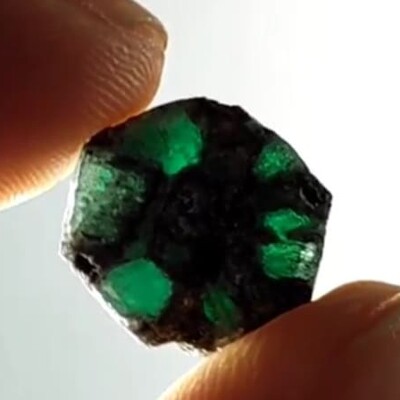
Trapiche emeralds are a rare and valuable type of emerald known for their distinctive six-spoke wheel pattern reminiscent of a sugar mill or trapiche. These striking gems have a long and storied history intertwined with the culture and geology of Colombia.
Trapiche Emeralds: The Six-Spoked Mystery
Trapiche emeralds sit in a category of their own. Recognizable by the six-spoke wheel pattern that looks like a sugar mill or trapiche, these stones attract collectors, jewelers, and investors. Colombia remains their spiritual and commercial home, though discoveries elsewhere have stirred global interest.
Cultural Roots in Colombia
Legends in Colombia credit lightning strikes from the god Bochica for creating the star-like spokes. For miners and jewelers across generations, these emeralds carry symbolic value, more than simple trade goods. National pride threads through their story, from indigenous communities to today’s cutters.
The Spanish first pulled Trapiche emeralds from Colombian ground in the 16th century. Their ruling elite paid handsomely for them, and emerald mining itself financed colonial expansion. The original Trapiche mine and later workings across the Emerald Belt built Colombia’s enduring reputation.
Rediscovery in Modern Times
By the 20th century, these gems had slipped from the spotlight. Their return came in the late 1900s, when collectors and traders noticed their unusual geometry again. Rarity coupled with visual intrigue brought demand back, especially in markets like New York where buyers prefer either loose stones or jewelry mounted with Trapiche inlays.
Interest grew fast. According to our analysts, that surge still hasn’t slowed, and every rediscovered parcel triggers excitement. Maybe it’s the symmetry. Maybe the impossible-to-fake spokes. Either way, the appetite is real.
Global Search for Trapiche Sources
Colombia dominates supply. The La Pita and Peñas Blancas mines, part of the “emerald triangle,” still produce examples of the highest quality.
Brazil entered the picture in the 1990s when miners in Bahia pulled emeralds with trapiche-like patterns. Their spoke count often runs low, but collectors admire the unusual bluish-green color.
Pakistan’s Swat Valley produced emerald crystals with stellate structures attached. They lack clarity but compensate with sheer size. Madagascar added its name to the map too, though the finds there lean toward golden-green beryl with fused spokes rather than true emerald.
Exploration continues. Each fresh pocket—regardless of location—sparks new investment.
Anatomy of the Trapiche Effect
The spoke effect forms when crystal growth stalls, interrupted by aluminum-rich inclusions. Those barriers force light into star-shaped reflections. Six spokes dominate, yet some stones show three, others up to twelve.
Color shifts with chemistry. Vanadium, manganese, sodium, and opaque minerals scatter through the structure, breaking uniformity. Greens vary from forest to blue-tinged teal. Spoke thickness ranges from needle-thin lines to heavy black arms. Transparency changes too, from near-clear windows to near-opaque blocks.
The outcome? Each Trapiche stands alone. A cocktail of rare conditions, hardly ever repeatable.
Value and Authentication
Price per carat rests on familiar factors: color intensity, sharpness of spokes, transparency, and weight. Larger gems multiply in value fast. Stones over 5 carats, flawless and sharply defined, can reach $50,000 per carat.
Special features—like contact twinning where spokes intersect—push prices higher still. On the lower end, 1-2 carat Trapiches start around $3,000 per carat.
Certification is non-negotiable. Some labs have seen attempts to imitate spokes with treatments. Only respected authorities like GIA or AGL can confirm authenticity. Raman spectroscopy often delivers the final proof. Without papers, buyers should expect steep discounts.
Investment and Collectibility
Trapiche emeralds appear in roughly 1 out of 10,000 stones. That math alone drives scarcity pricing. Unlike commercial emeralds, their geometry cannot be replicated reliably. For collectors, that’s the hook. For investors, it’s the hedge.
In New York, portfolios that include certified Trapiche emeralds—museum quality, transparent origin—have delivered stronger growth than more common gems. Dealers see long-term buyers anchoring positions with them.
We think Trapiche emeralds will hold their edge. Their story is too strange, their supply too thin. For anyone looking to acquire, work only with reputable sellers. Our store in New York City provides vetted emeralds, rubies, sapphires, and more. Loose stones, mounted jewelry, everything catalogued online at vividcarat.com.