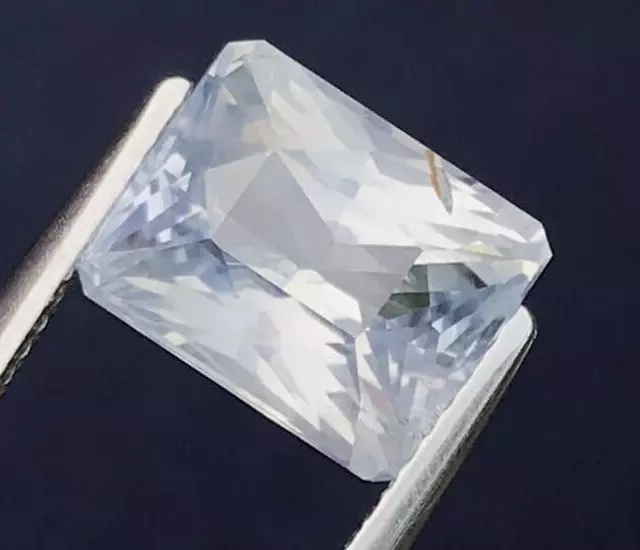
White Sapphires: The Stone That Makes the Diamond Argument Collapse
By Russell, VividCarat — China Fort Market, Beruwala, Sri Lanka
My friend Steve from London — we went to school together — came to me with a problem. He'd found the right person and wanted to propose. He'd also looked at diamond prices and done the math, the way engineers do.
A diamond under 5 carats loses significant resale value immediately. You walk out of the store and it's already worth substantially less than you paid. A 2-carat diamond at a decent quality level costs serious money and depreciates the moment it leaves the shop. A 5-carat diamond — the size where the stone starts to hold value better — was outside his budget entirely.
He came to me. Russell, what do I do?
I gave him two options. The first: a blue sapphire, classic, the ring that Diana wore. The second: something no one else would have. I would find him a white sapphire — enormous, flawless, the kind of stone that makes people stop and ask questions. Ten or more carats. Perfect characteristics. At the cost of a 3-carat diamond.
I'm his friend. I wasn't planning to make money on this. He paid expenses only. Yes, sometimes being friends with me has its advantages.
Three weeks of searching across Sri Lanka and Madagascar. Then I found it — a 25-carat rough that had the clarity and character I was looking for. I sent it to my best cutter in Bangkok. Another week. Then certification.
When I posted the finished stone on social media with the caption "sold" — the response was unlike anything I'd seen. Everyone wanted those 10+ carats of perfect colorless corundum. The stone proved a point the market already knows but rarely articulates: at large carat weights, white sapphire has no competition in its price bracket.
The Diamond Comparison That Actually Holds
White sapphire is Mohs 9 — second only to diamond. It doesn't scratch from daily wear. It doesn't require the protective settings that softer stones like morganite or white topaz demand. For a ring worn every day for decades, it performs.
Where it differs from diamond is optical: diamonds have higher refractive index and dispersion, which produces the "fire" — the rainbow flashes in bright light. White sapphire produces brilliance but less fire. In practical terms: a well-cut white sapphire in normal indoor lighting looks exceptional. In direct sunlight next to a diamond, the difference is visible to a trained eye.
For most buyers, that trade-off is not a trade-off at all. The comparison that matters:
| 2ct Diamond (fine) | 10ct White Sapphire (fine) | |
|---|---|---|
| Approximate cost | $15,000–$25,000 | $4,000–$11,000 |
| Resale value trajectory | −30% immediately | Stable at source price |
| Hardness | Mohs 10 | Mohs 9 |
| Fire / dispersion | High | Moderate |
| Size on finger | 8mm | 14mm+ |
The engineering logic Steve applied was correct. You are not buying equivalent objects. You are choosing between a depreciating asset in a smaller size and a large, durable, certified natural stone that holds its sourcing price.
What Fine White Sapphire Actually Costs
The prices circulating online ($20–$250/ct) describe commercial, included, or heavily treated material. Fine white sapphires look different:
| Grade | Carat | Market Range |
|---|---|---|
| Eye-clean, slight tint, heated | 1–3 ct | $280–$440/ct |
| Near colorless, eye-clean, heated | 1–5 ct | $440–$600/ct |
| Near colorless, eye-clean, Sri Lanka | 5–10 ct | $600–$950/ct |
| Crystal white, loupe-clean, large | 10ct+ | $950–$1,100/ct |
Based on current dealer prices for certified Sri Lankan material.
The price-per-carat on large white sapphires does not escalate the way colored sapphires do. A 10-carat blue sapphire costs exponentially more than a 1-carat blue sapphire. A 10-carat white sapphire costs roughly proportionally more than a 1-carat white sapphire — which is precisely what makes the large-carat proposition so compelling.
The Clarity Question
White sapphires are colorless, which means inclusions are more visible than in colored stones where saturation provides camouflage. A slight inclusion that disappears inside a vivid blue becomes immediately obvious in a colorless stone.
This is why the Steve stone took three weeks to find. Rough of that size with clean clarity is not common. When you see it, you know. The cutter in Bangkok understood what he was working with — he took his time to maximize the window of brilliance and minimize waste. The result was a finished stone that looked, to the untrained eye in a platinum setting, like a diamond.
The certificate confirmed: natural corundum, Sri Lanka origin, eye-clean.
When White Sapphire Is the Wrong Choice
Don't buy white sapphire expecting diamond fire. The optical difference is real and visible in direct sunlight or gem show lighting. If the buyer needs the rainbow dispersion, this is not that stone.
Don't buy commercial grade material at fine grade prices. White sapphire at $50/ct exists and is heavily treated, included, or both. Any stone being sold as "natural fine quality" without a GIA or AGL certificate stating colorless or near-colorless with eye-clean clarity is a different product.
Don't use white sapphire in channel settings without protective prongs on larger stones. Mohs 9 resists scratching but can chip on hard impacts at facet edges — the same precaution applies to any corundum.
FAQ
Is white sapphire a real alternative to diamond? For visual similarity in a setting, yes — with honest caveats. White sapphire lacks diamond's dispersion, which produces fire. In normal indoor lighting, a well-cut white sapphire looks exceptional. In direct sunlight next to a diamond, the difference is visible. For buyers who care about size, durability, and natural origin over the specific optical behavior of diamond, white sapphire is a genuinely compelling choice — not a compromise.
How do I know if my white sapphire hasn't been coated to appear whiter? A GIA or AGL certificate states treatment status explicitly. Coating is flagged as an enhancement. Over 95% of natural white sapphires sold have been heated — this is standard and acceptable. Coating is a different category and must be disclosed. Any seller who cannot provide a certificate addressing treatment status is selling you their word, which is worth nothing for a purchase at this level.
How to Buy From Me
Finding the right white sapphire — large, clean, genuinely colorless — takes the kind of search I did for Steve. Three weeks across two islands. That search is what I do for clients who come to me with a specific brief.
Book a Zoom call. Tell me the carat target, the clarity requirement, the budget. I'll tell you honestly whether that combination exists in the market right now and what it would take to find it.
→ Book a Zoom consultation | No deposit, no commitment