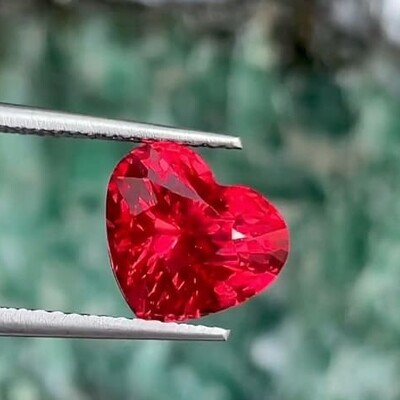
Mahenge Spinel: What I Saw at the Mine in 2026 and What It Means for Buyers
By Russell, VividCarat — China Fort Market, Beruwala, Sri Lanka | March 2026
Every article about Mahenge starts with the same story: 2007, a 52-kilogram crystal, miners who didn't understand what they'd found. That story is true and fifteen years old. I was at Mahenge in March 2026. What I saw was more relevant to buyers right now.
At the washing table
The operation has changed. In 2007 you pulled out giants. In 2026 the work is surgical — smaller seams, more careful extraction, less yield per cubic meter. I was standing at the washing table when they brought up a crystal — octahedral form, maybe 4 centimeters across, sitting in a white marble matrix. Under direct sun it looked like a piece of glowing coal. Not red, not pink — something in between that has no name in ordinary color vocabulary. Vibrant Neon Pink-Red.
Mahenge spinel forms in two geological contexts: marble-hosted seams and graphite-adjacent deposits. The graphite seams consistently produce the clearest material — the pressure conditions during crystal growth create exceptional clarity in stones that would normally be heavily included at that size. When a dealer shows you a 5-carat stone with VS clarity, ask which seam it came from.
What's changed in 2026 is volume. At Tucson 2025, dealers reported that quality Mahenge had effectively vanished from the open market. The richest Ipanko pockets have been worked since 2007. No significant new deposit has been found. What's coming out now is real, fine, and there's less of it every season.
Is Mahenge Spinel right for your budget?
Direct answer before the technical details.
Under $1,500/ct: Entry-level Mahenge commercial — visible inclusions, lighter saturation. Still genuine Mahenge origin, still the characteristic pink-red. Good for jewelry buyers who want the stone without the collector premium.
$1,500–4,000/ct: Fine Vivid Pink-Red, 1–2ct, minor inclusions, GIA or SSEF certified. Core jewelry buyer range. The open tone effect is present but not at full intensity — smaller stones have less mass to work with.
$4,000–8,000/ct: 2–5ct Vivid, the core investment range. This is where open tone becomes pronounced and the stone performs across all lighting conditions. The size that most clearly demonstrates what makes Mahenge extraordinary.
$8,000–18,000/ct: 5ct+ vivid, GRS certified. Collector-grade. Supply contracting visibly year over year.
$18,000–35,000+/ct: Top neon, exceptional clarity, GRS with explicit Mahenge designation, 5ct+. Zürich benchmark — this is what serious collectors are paying in 2026 for the best material.
Why Mahenge doesn't darken at 10 carats
Most red gemstones become over-dark as carat weight increases — the stone absorbs more light, color saturates past beauty, and you end up with something that looks almost black except in direct sunlight. Jewelers call this extinction.
Mahenge doesn't do this. A 10-carat stone can display the same vivid pink-red as a 1-carat stone. The reason is the chromium-to-iron ratio. Iron creates absorption bands that kill color saturation in low light. Mahenge spinel has near-zero iron — chromium carries the color alone, and chromium fluoresces. The result: even in a dark bar, at a candlelit dinner table, in the dim light of a European winter afternoon, the stone continues to emit rather than absorb. I call this the internal lantern effect.
I demonstrate this at every client viewing. I turn off the overhead light. Most red stones immediately lose half their character. The Mahenge changes almost nothing. This is the argument that closes sales in markets where the stone will actually be worn — London, Munich, New York in November.
The apatite argument
In January 2026 I closed a sale in Zürich. The stone was 6.5 carats, clean neon from Mahenge, GRS certified. My client looked at the stone under a 10x loupe and asked about the fine needle-like inclusions visible at magnification.
Most dealers apologize for inclusions. I said this: "Those are apatite needles. That's the geological signature of Mahenge. In five years, when this deposit is exhausted — and it's close — those inclusions will prove origin without any paper. You're not looking at a flaw. You're looking at a fingerprint that cannot be replicated anywhere else on earth."
He bought the stone at $35,000/ct. For reference: in 2021 a comparable stone was $12,000. That's 191% in five years while the stone sat untouched in a safe.
Cutting in Sri Lanka: handling the orange undertone
Mahenge rough frequently carries an orange secondary hue. My approach with my Sri Lanka cutter: never cut Mahenge with a deep pavilion. Maximum table opening, shallow pavilion angle. For stones where orange is strong, I ask for cushion cut with double-row crown facets. This breaks the orange into discrete flashes — small bursts of warm gold firing inside the dominant pink-red. Instead of a stone that reads vaguely orange, you get a stone that reads red with internal fire. The difference in sale price between a stone cut this way and one cut for weight retention is significant.
What you pay buying direct
Verified April 2026:
| Grade | Size | Price/ct | Notes |
|---|---|---|---|
| Commercial | 1–2 ct | $800–$1,500 | Visible inclusions, genuine origin |
| Fine Vivid Pink-Red | 1–2 ct | $1,500–$3,900 | Entry investment range |
| Fine Vivid Pink-Red | 2–5 ct | $3,900–$7,000 | Core investment range, open tone visible |
| Fine Vivid Pink-Red | 5+ ct | $7,000–$18,000 | Rare, moves fast |
| Top Neon, GRS certified | 5+ ct | $18,000–$35,000+ | Zürich benchmark |
VividCarat direct runs 35–50% below retail.
Book a Zoom consultation — I show the stone under overhead light, candlelight simulation, and direct sun. You see the internal lantern effect live on camera. No deposit, no commitment.
When NOT to buy Mahenge
You want a stone under 1.5ct — the open tone effect that defines Mahenge requires mass. Small stones are fine but don't demonstrate what makes this deposit extraordinary.
You need pure red without pink — Mahenge always carries the pink-red signature of its chromium profile. Clean red with no pink means Burma ruby or Vietnam Jedi spinel.
No GRS or Gübelin certificate with explicit "Tanzania, Mahenge" origin confirmation — without this it's a marketing claim.
You need auction liquidity within 12 months — Mahenge is appreciating but auction market for this material is still developing. Burma ruby moves faster at Christie's today.
FAQ
What makes Mahenge different from other Tanzanian spinel? Specific geology — the Ipanko deposits in Morogoro region, marble-hosted system with near-zero iron. Other Tanzanian spinel exists but doesn't share the chromium-to-iron chemistry that produces neon fluorescence. "Tanzania, Mahenge" on a major lab certificate is a specific origin claim, not a marketing term.
Are the apatite needles a defect? At 10x they're visible. Face-up in normal viewing a well-cut Mahenge reads eye-clean despite them. More importantly: they're origin-specific inclusions that function as a geological fingerprint. Clients who understand this don't ask for a discount — they ask for a second stone.
Vietnam Jedi or Mahenge for investment? Different arguments. Vietnam is a flash — extraordinary intensity in small sizes, extreme rarity above 2ct, already priced at peak levels. Mahenge is continuous burn — larger sizes, open tone across weight range, deposit depletion driving appreciation. For a five-year hold, I choose Mahenge 3ct+ with GRS certification.
How do I verify genuine Mahenge? GRS, Gübelin, or SSEF origin report stating Tanzania, Mahenge explicitly. Under magnification: oriented apatite needle inclusions and octahedral growth patterns. UV fluorescence is strong and characteristic but not sufficient alone for origin confirmation.
Is the 191% appreciation since 2021 realistic going forward? The rate will slow as the stone becomes more widely known and priced by the market. But the supply constraint is real and measurable — I saw it on the ground in March 2026. The direction is not in question.