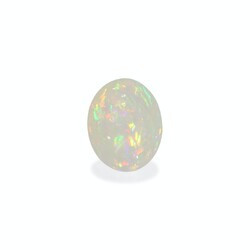
The Problem Most Opal Buyers Run Into
By Russell, VividCarat — China Fort Market, Beruwala, Sri Lanka
The Problem Most Opal Buyers Run Into
When someone searches for opals online, they usually find one of two things: a jewelry store selling doublets at inflated retail, or an article explaining that ancient Greeks believed opals gave prophetic vision.
Neither helps you buy a stone.
What actually matters when you're considering an opal purchase — especially in the $500–$15,000 range — is understanding three things: origin, play-of-color pattern, and whether the stone is solid or composite. Everything else is secondary.
I'll take each in order.
Ethiopian vs Australian vs Mexican: What the Origin Actually Means
Most opals on the market today are Ethiopian, specifically from the Wollo Province deposits discovered around 2008. Before that, Australia — Lightning Ridge for black opal, Coober Pedy for white — dominated the trade completely.
Ethiopia changed the economics of the category. Similar play-of-color to Australian material, available in significantly larger sizes, at prices that made the stone accessible to buyers who couldn't justify Australian black opal at $5,000+ per carat.
The trade-off is stability. Ethiopian opal is hydrophane — meaning it absorbs water. Put it in water and it goes temporarily transparent. Let it dry and the play-of-color returns. This characteristic also makes it sensitive to sudden humidity changes. For most people, in most conditions, this isn't a practical problem. For someone planning to swim with the ring on daily, it becomes relevant.
Australian opal is older in geological terms, more stable, and commands premium pricing that reflects both rarity and collector demand. When I source Australian pieces, the supply is tighter, the price floor is higher, and the ceiling is wherever a collector decides to stop bidding.
Mexican fire opal is a third category entirely. No play-of-color in most specimens — instead, a body color that runs from yellow through orange into deep red. The effect is fire, not rainbow. Completely different optical phenomenon, different buyer profile.
| Ethiopian | Australian | Mexican Fire | |
|---|---|---|---|
| Stability | Hydrophane — absorbs water | Stable, less water-sensitive | Stable, brittle |
| Typical size | Large (2–20+ ct common) | Smaller, gem-quality rare | Small–medium |
| Play-of-color | Strong, full spectrum | Strongest (esp. black opal) | Rare / absent |
| Price floor | $80–200/ct (white, certified) | $300/ct+ (crystal); $1,500/ct+ (black) | $50/ct (orange); $200/ct+ (red) |
| Best for | Value, size, color variety | Collectors, investment | Statement color, pendants |
| Lab cert available | Yes — AIGS, GBS | Yes — AIGS, GIA | Yes — AIGS |
How to Read Play-of-Color
This is where opal buying gets technical, and where most buyers are underserved by the information available online.
Play-of-color has four qualities that gemologists evaluate independently:
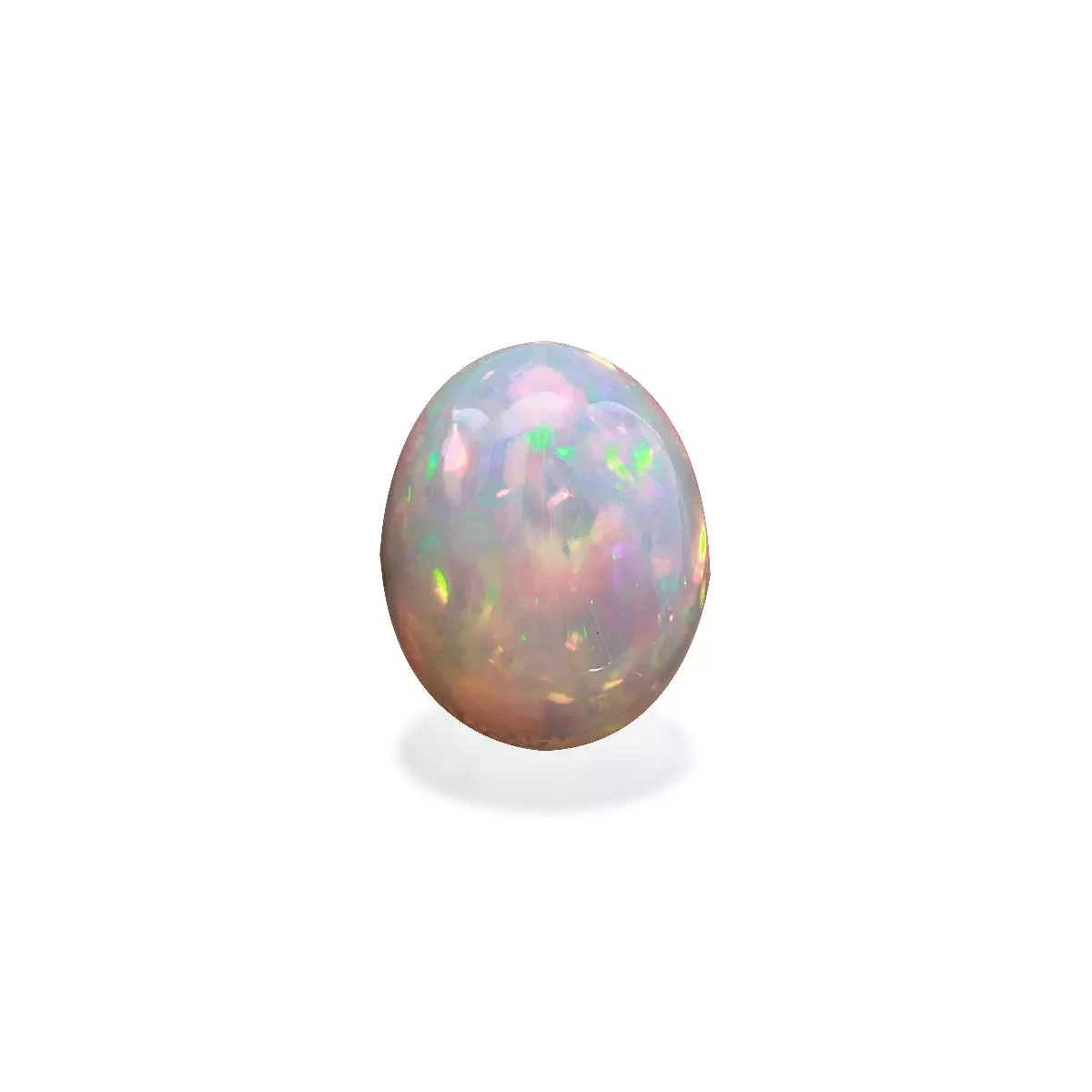
Pattern. The most valuable patterns have names: harlequin (large, distinct rectangular or diamond-shaped color blocks — extremely rare), rolling flash (broad sheets of color that move across the stone as you tilt it), pinfire (tiny, dense points of color). Irregular patterns are common. Clean harlequin is not.
Directional coverage. Does the play-of-color appear from every viewing angle, or only from a narrow window? A stone that only flashes when held at exactly the right tilt is worth less than one that shows color through a wide arc.
Spectral spread. Red is the rarest color in opal play-of-color. A stone showing full spectral coverage — red, orange, yellow, green, blue, violet — is significantly more valuable than one showing only blue and green, even if both look dramatic in a photograph.
Brightness. The intensity of the play-of-color against the body tone. Darker body tone — black or dark base opal — makes color appear brighter because of contrast. White base opal shows the same colors but they read softer against the pale background.
When I show stones on Zoom, I move them deliberately through different angles and hold them toward both direct and diffuse light. I cover roughly a 120-degree arc in the first 60 seconds. A photo captures one frame. The stone is a video — and that difference is the single biggest reason why opal photos mislead more than any other gemstone category.
Solid, Doublet, Triplet: The Difference That Changes the Price
This is the single most important distinction for any buyer.
Solid opal is what it says — a single piece of natural opal material, cut and polished. No backing, no coating. This is what VividCarat sells.
Doublet is a thin slice of natural opal, bonded to a dark backing — usually ironstone or black potch. The backing darkens the appearance and amplifies play-of-color. The result looks like a black opal at a fraction of the price. It is not a black opal. On gemstock.org, Australian doublets currently list at $83–85/ct. A comparable-looking solid Ethiopian black base opal starts at $200/ct certified. Disclosure varies wildly across the market.
Triplet adds a domed cap — usually glass or quartz — over the opal slice. The dome protects the thin opal layer and acts as a magnifier. Again: looks impressive, price is low, composite nature frequently undisclosed.
How to identify without a loupe: solid opal shows the same body color from the side as from the face. A doublet shows a distinct dark layer visible from the side — often a sharp horizontal line where the opal ends and the backing begins. A triplet shows a clear domed layer at the top, usually with a slight glassy reflection. If someone is selling you a "black opal" at $30–60/ct and won't show you the side profile on video, that's a doublet or triplet.
At China Fort, I see all three. The lab certificate on every stone I sell identifies the material explicitly as natural, solid opal. That's not a formality — it's the document that tells you what you're actually buying.
Buyer FAQ
Can Ethiopian opal be worn daily? Yes, with the right setting. A bezel setting protects the edges; prong settings leave the stone more exposed. Avoid submerging it daily or going from extreme cold to direct heat. Treated with ordinary care, a solid Ethiopian opal in a protective setting lasts decades.
How do I spot a doublet without a loupe? Ask to see the side profile on video. A solid opal has consistent color and material from edge to edge. A doublet has a visible horizontal join line — the opal layer sitting on top of the dark backing. It takes about five seconds to check.
Does opal need special care in dry climates? Ethiopian opal is hydrophane and can become more brittle in very low humidity over time. Storing it away from air conditioning vents and not leaving it in a car in direct sun is enough for most climates. Australian opal is less sensitive to this.
Is a GBS or AIGS certificate enough, or do I need GIA? For opal, AIGS and GBS are the appropriate labs — GIA does not routinely grade opal in the same way it grades diamonds. An AIGS or GBS certificate confirms natural origin, solid (not composite) material, and treatment status. That's what matters for the purchase decision.
What play-of-color pattern is rarest? Harlequin — large, distinct, angular color blocks covering most of the face. True harlequin is genuinely rare; most stones described as harlequin in listings are rolling flash at best. I've handled maybe four stones in two years that I'd call true harlequin without qualification.
Pricing: What the Market Actually Looks Like
These ranges come from current listings on gemstock.org, gemval.com, and IGS (2025–2026), cross-referenced against what passes through China Fort.
Ethiopian white opal, solid, good play-of-color, certified: Gemstock lists large Ethiopian white at $200/ct. US jewelry store retail for comparable material: $200–500/ct, often uncertified or doublet. VividCarat direct: $80–150/ct certified solid.
Ethiopian black base opal, strong play-of-color: Gemstock: $200/ct (11.56 ct stone at $2,308). US retail equivalent: $300–600/ct. VividCarat direct: $150–350/ct.
Australian white opal (Coober Pedy), solid: $30–300/ct retail depending on play-of-color brightness and clarity. Fine quality starts at $150/ct; strong play-of-color pushes past $250/ct.
Australian black opal (Lightning Ridge), certified: $1,500–20,000/ct retail. Top gem quality with full-face color and strong pattern: $5,000+/ct. This is a collector category, not an everyday purchase.
Boulder opal (Queensland): $100–3,000/ct depending on color intensity, pattern, and ironstone ratio. Mid-range strong specimens: $300–800/ct.
Mexican fire opal, faceted, vivid orange-red: $50–300/ct for standard quality. Vivid red-orange with transparency: $200–500/ct. Fire opal with play-of-color (rare): $500+/ct.
Doublet (for comparison only — not what we sell): $83–85/ct on gemstock for Australian doublet cabochon. If a "black opal" is priced here, it is not solid.
A note on certification: opal lab reports from AIGS or GBS confirm natural material, solid construction, and origin. They don't assign a play-of-color grade on a fixed scale the way GIA grades diamond cut. The certificate is necessary but not sufficient — which is why I show every stone on video before any commitment.
What I Look for at China Fort
The opal section at China Fort is smaller than the sapphire section, which makes sense — Sri Lanka doesn't produce opal. What comes through is traded material, mostly Ethiopian, some Australian parcels.
I pass on a lot of stones. The most common reason: strong photography potential, weak directional coverage. A stone that photographs bright but only shows color from a 10-degree window becomes a frustrating piece of jewelry. Once it's set and on a hand, that narrow angle is a real limitation that no amount of good photos communicates.
The second reason I pass: signs of smoke treatment. There's a process sometimes applied to Ethiopian opal — exposing it to smoke temporarily darkens the body tone to simulate black opal. It fades within months. Under magnification, smoke-treated stones often show an uneven surface coloration that doesn't penetrate the body. I check and pass anything that doesn't look right.
What I buy: stones where play-of-color is genuine, visible from a wide viewing angle, and where the pattern has character — not just flat blue-green, but movement across the spectrum. If it doesn't look impressive in a phone camera video under a desk lamp, it won't look impressive in someone's home.
When Opal Is the Wrong Choice
This is information most dealers won't give you, but it matters.
Daily-wear ring, active lifestyle, no protective setting: Opal at 5.5–6.5 Mohs scratches more easily than sapphire or ruby. If the ring will take daily knocks without a bezel, consider whether a harder stone is a better fit, or choose a pendant or earring setting instead.
Very dry climate, frequent swimming pools: Ethiopian hydrophane opal is more sensitive to extreme humidity swings than Australian material. Chlorinated water daily is not ideal for any opal long-term.
Buyer requires GIA certificate specifically: GIA does not routinely issue grading reports for opal the way it does for diamonds and colored stones. If a specific client or context requires GIA documentation, opal is not the right category.
Budget under $200 total for a "black opal": At this price, you're buying a doublet or triplet. A solid black opal at any quality starts significantly higher. If the budget is firm and the look matters more than material, a doublet disclosed as such is a legitimate choice — but it should be sold and priced as a doublet, not as solid.
The Stones Currently in Stock
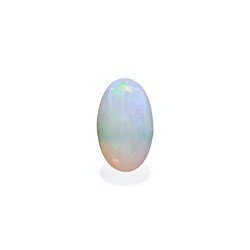
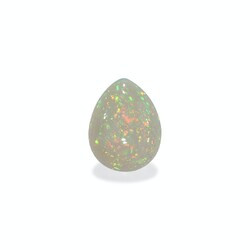
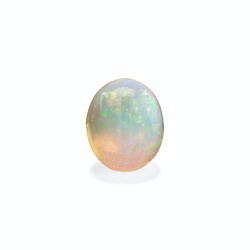
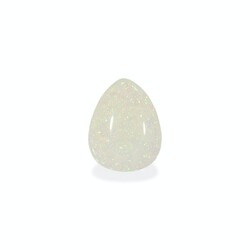
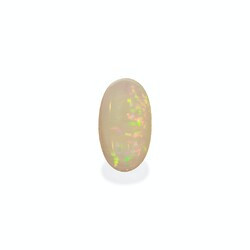
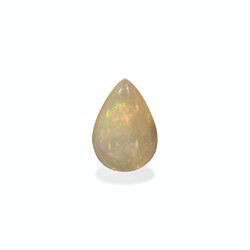
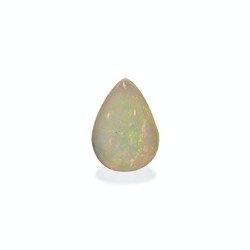
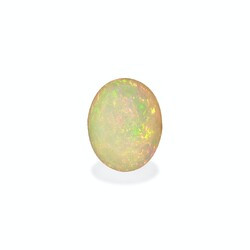
What's online represents a fraction of what I can source. The stones on this page are pieces I selected personally — all lab-certified, all solid natural opal, all with video available before purchase.
If you're looking for something specific — a particular size, a specific pattern, a stone for a custom piece with exact dimensions — book a Zoom call. Thirty minutes. I'll show you what I have in hand, and if I don't have it, I'll tell you what it would take to find it.
No deposit. No pressure. See the stone before you decide.