


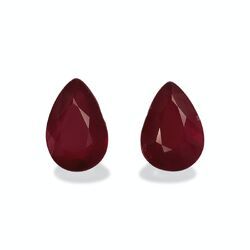


Natural Ruby Gemstones — Certified, Direct-Source, Priced Honestly
By Russell, VividCarat — China Fort Market, Beruwala, Sri Lanka | October 2025
October 2025. My lab, late evening. Two stones in front of me — both 3 carats, both GRS certified unheated. One from Mogok, Burma. One from Montepuez, Mozambique. A client is prepared to spend a serious amount of money. My job is not to trust the paper — it's to read the stones.
I turn off the overhead light and pick up my blue laser pointer. The beam touches the Burmese stone's facet. The ruby explodes red. Chromium inside is firing photons back at me in the red spectrum — this is the Stokes shift, chromium doesn't just absorb light, it re-emits it. The stone returns more red than it receives. My fingers glow pink from the reflection.
The Mozambique stone responds differently — calmer, deeper, more contained. The iron in its lattice is doing what iron always does: suppressing the fluorescence chromium wants to produce. Both stones are genuine. Both are unheated. But the physics of Burma is different. In Mogok marble-hosted deposits, iron levels are extraordinarily low. Chromium operates at full power. That's the physical reason Burma costs three times more — not history, not prestige. Chemistry.
I've been to Mogok. Getting there requires timing your visit around armed conflict, a separate entry permit, and accepting the situation can change faster than your travel plans. I heard gunfire on all five days. The best stones move through families who've been in this business for five generations. There was no negotiation on the finest pieces. There rarely is.
Rubies are the most emotionally charged stone in the market — and the most abused. Treatment disclosure gets buried, origin claims go undocumented, the same stone at $200 on one platform appears at $2,400 on another. This page exists to cut through that.
What you'll actually pay: ruby price ranges by quality
Direct-source level. Retail jewelry stores typically add 2–4× on top.
| Quality Grade | Carat Weight | Treatment | Price (USD/ct) | Certificate |
|---|---|---|---|---|
| Commercial | 0.3–0.8 ct | Heated | $150–600 | None required |
| Fine | 0.8–2 ct | Minor heat | $800–3,500 | GRS or GIA |
| Fine Burmese | 1–2 ct | Minor heat | $2,500–6,000 | GRS strongly recommended |
| Fine Burmese | 1–2 ct | No heat | $5,000–12,000 | GRS required |
| Investment | 2 ct+ | No heat, Pigeon Blood | $12,000–35,000+ | GRS + Gübelin |
Mozambique fine material runs 30–50% below equivalent Burmese grades. Prices shift with certificate lab, color saturation, and clarity.
Is a Burmese ruby right for your budget?
Under $500: Certified Burmese at this budget means very small or commercial grade. Fine Mozambique with GIA documentation delivers significantly more stone for the money.
$800–2,500: Mozambique fine rubies and lower-end Burmese heated material with GIA or GRS certification. Expect 0.5–1.2 ct, good color, standard heat treatment.
$2,500–8,000: Burmese origin with GRS documentation, minor heat, 1–2 ct. Core buy-and-hold range for collectors who want both beauty and resale credibility.
$8,000+: Unheated Burmese with GRS "No Heat" designation, Pigeon Blood grading possible. Investment-grade territory. Every fraction of carat matters here.
GRS vs GIA vs AIGS: Which Certificate Matters for Rubies
GRS is the benchmark for Burmese rubies. They introduced the "Pigeon's Blood" color grade and their Burma origin determination is the most trusted in the trade. For any stone above $3,000/ct, GRS is non-negotiable. Modern GRS origin determination uses LA-ICP-MS — laser ablation mass spectrometry — measuring magnesium, gallium, and vanadium ratios down to parts per million. Every mine on earth has a chemical fingerprint. GRS reads it.
GIA is excellent for US buyers — highest brand recognition, reliable origin determination. Appropriate for stones under $3,000 and for buyers reselling into US retail.
AIGS is respected in the Asian trade, faster turnaround, lower cost. Acceptable for commercial and mid-range stones. Less recognized by US and European collectors for high-value pieces.
Gübelin paired with GRS is the standard for collector-grade material above $10,000/ct.
What to look for on any ruby certificate: origin determination with confidence level, heat treatment status, color grade if present, weight and dimensions. The treatment line is most critical — "No indications of heating" on GRS separates a $3,000/ct stone from a $9,000/ct stone of otherwise similar appearance.
Pigeon Blood: what the term actually means
GRS introduced Pigeon Blood as a formal colour grade — a defined position in colour space combining specific red hue, saturation, tone, and strong UV fluorescence. Both criteria must appear on the GRS report.
Here's what most listings don't tell you: a stone that is over-dark cannot be Pigeon Blood regardless of how it looks. High iron content suppresses chromium fluorescence — and strong fluorescence is a required component of the grade. This is not a subjective judgment. It's a spectroscopic measurement. A Mogok ruby with too much iron may look deep red to the eye and still fail the Pigeon Blood threshold at GRS.
Most rubies sold online as "pigeon blood" carry no GRS certificate. The term is being used as a colour description. A GRS report explicitly stating "Pigeon's Blood" in the colour section is the only documentation that means anything for pricing.
Heat Treatment: What "Minor Heat" Actually Means
Most rubies are heated. This is not automatically a problem — it's been standard practice for centuries. The issue is undisclosed treatment or misrepresented degree.
"No indications of heating" — no evidence of heat application found under laboratory examination. Rarest and most valuable. Only these stones appreciate reliably as investments. How to verify beyond the certificate: I look for rutile silk under magnification — fine needles crossing at 60 and 120 degrees. Heating above 1,200°C dissolves rutile silk; the needles melt into rounded droplets or disappear. Intact silk is a 100% indicator of no heat treatment. I can show this on video during a Zoom consultation.
For Burma specifically, I also look for calcite crystal inclusions. Burmese rubies grow in marble. Tiny transparent calcite crystals locked inside the stone are a geological passport — proof the ruby formed in marble host rock, not the metamorphic schist typical of African deposits. Calcite inside a ruby under magnification is near-confirmation of Burmese origin independent of any certificate.
"Indications of heating / Minor heat" — heat applied, natural characteristics largely preserved. Color genuine, treatment enhanced rather than transformed. Majority of fine commercial rubies. Acceptable for jewelry buyers.
"Indications of heating to a high degree / Significant heat" — extensive treatment, sometimes with flux or glass filling. Not investment-grade. Common red flag in budget online listings.
Fracture filling (lead glass) — a different category. Glass-filled rubies are fragile, damaged by ultrasonic cleaners, worth a fraction of natural stones.
Burmese vs Mozambique Rubies: Which Makes More Sense to Buy
| Factor | Burmese Ruby | Mozambique Ruby |
|---|---|---|
| Color character | Warm red, strong UV fluorescence, "living" quality | Slightly cooler red, less fluorescence, still fine |
| Treatment rate | ~85% heated | ~90%+ heated |
| Unheated premium | 3–5× over heated | 1.5–2× over heated |
| Investment resale | Strong — GRS Burma commands collector premiums | Moderate — growing recognition since ~2010 |
| Value per dollar | Lower — you pay for origin | Higher — same visual at lower cost |
| Availability 1–3 ct fine | Scarce, rising prices | More accessible |
For beauty and daily wear: Mozambique fine material with GIA documentation is an excellent choice. Most people cannot see the fluorescence difference in normal lighting. For resale or inheritance: Burmese origin with GRS is worth the premium.
Where the Price Goes Between Mine and Your Finger
A Burmese ruby leaves Mogok through a local broker → Mandalay dealers → Bangkok cutters and labs → international wholesalers → US retailers at 100–300% markup. Each step adds 20–60%. Four or five intermediaries before it reaches a store.
We work out of Beruwala with direct Bangkok contacts. We sell at one markup above the Bangkok dealer level — not five. That's where the 40–60% gap versus US retail comes from.
Verifying the stone yourself
One field test I run before every purchase and show live on Zoom: I rotate the stone under a directional light source. Natural ruby is doubly refractive — anisotropic — and shows two colours simultaneously through a dichroscope: purplish-red and orangey-red. A stone that looks perfectly uniform from every direction is either synthetic or glass. Natural ruby always resists uniformity. The moment a client sees the same stone show two different reds at once, they understand what they're paying for.
When a Ruby Isn't the Right Choice
Budget under $500, want Burmese with GRS — the math doesn't work. Fine Mozambique with GIA delivers more stone.
Want unheated at heated prices — the premium is real and documented. If budget is set for heated material, that's what the search finds.
Buying for someone who will clean it without knowing treatment status — fracture-filled rubies are damaged by ultrasonic cleaners. Proper certification is not optional.
Expecting collector-grade appreciation from commercial material — fine unheated Burmese above 2 ct with GRS has shown strong long-term retention. Commercial heated at $300–600/ct has not.
How a Consultation Works — Step by Step
Step 1 — Tell us what you need. Budget, use (jewelry / collection / investment), size, treatment, origin preferences. No deposit, no commitment.
Step 2 — We source and present. 3–5 stones pulled from inventory or Bangkok network. You see each on video — natural light, UV, color reference — certificate open on screen.
Step 3 — You decide. No pressure. If nothing fits, we look further or part ways without obligation.
Step 4 — Payment and shipping. Wire transfer, SWIFT, major cards. Stones ship insured with full tracking and export documentation.
Step 5 — 14-day inspection window. Full refund on untouched, unmodified stones. Contact us first for an RMA number before sending anything back. Refunds within 5–7 business days of receiving and approving the return.
Common Questions Before Buying
"How do I know the origin claim is genuine?" Origin is determined by a laboratory, not by us. Every stone we sell with a Burmese origin claim comes with a GRS or GIA certificate stating the origin finding. You can verify the certificate number directly on the lab's website before payment.
"Can I have the stone independently tested after I receive it?" Yes. We encourage it. Any reputable local gemologist with a spectroscope can confirm the certificate matches the stone. If it doesn't, the return window applies.
"What if I want a stone set into jewelry?" Have it set only after you've decided to keep it. Once a stone is set, it typically cannot be removed without risk of damage, which voids the return eligibility. We'd rather you take the time you need than rush into a setting.
"Do you sell synthetic or lab-grown rubies?" No. Every stone in our catalog is natural. Certificates from GRS and GIA specifically confirm natural origin as part of their standard testing.
"What's the minimum order?" None. We work with single stones starting around $300.
A Note on Where We Source
Most of what we carry passes through the Bangkok network — the hub for Southeast Asian ruby material, including Burmese stones. We also source directly in Beruwala, Sri Lanka, which gives us proximity to dealers who handle material from both Sri Lanka and neighboring supply chains.
The Mogok valley in Myanmar remains the most historically significant ruby source. Material from there doesn't always come with a tidy paper trail at the mine level — it rarely does. What matters is what happens in Bangkok: the cutting, the certification, the documentation that creates a verifiable chain of title. We work with cutters and dealers whose material we've reviewed over time, not first-time transactions.
When a collector in Los Angeles needs a Burmese ruby with clean documentation, we know where to look. When a buyer in London needs three matched stones for a suite, we work the Bangkok network to find compatible material. These are different problems — and both require a different approach than browsing a marketplace.
Browse current ruby inventory below, or book a free Zoom consultation to discuss what's available at your budget right now.